
This week I joined a panel at an AI for FMCG Marketers session organised by the Singapore Economic Development Board (EDB) and Ximpact, run by Dr Ralph Ostertag. The question underneath every question was the same: where do we actually start?
My answer surprised a few people. Not with a tool. Not with a vendor. With yourself.
AI transformation is a human transformation first. The technology is moving light years faster than people and organisations can. Building something is now the easy part. Getting people to understand it, trust it and change how they work around it is the hard part. So here is how I think about it, and then how I live it, with the AI setup I run in my own life.
The research is starting to say the same thing. Anthropic’s economists have just published Working with AI, based on 66 interviews at 58 companies using Claude. Top-down automation, where leadership picks a workflow and rolls out a solution, tends to create job insecurity, fears of surveillance and resistance from exactly the experts you need to make it work. Handing out tools and waiting for bottom-up adoption produces pockets of brilliance, but uneven take-up and single-task fixes. The biggest value came from companies that reorganised roles and the way work gets done around AI. Same technology, very different results. The difference was people.
Three things you need, and only one of them is technology
1. Understand the work before you touch it. You cannot automate what you don’t understand. Before any AI goes near a process, you need to know the business or capability end to end: the inputs, the outputs and, above all, the outcomes. What goes in, what comes out, and what actually changes because of it. Most failed AI projects automate a step. The good ones reinvent the process, starting from the outcome and working back. Think of a sausage factory: you don’t fix one machine on the line, you redesign the line.
Experience matters here more than ever. You need to have done the work to judge whether an AI has done it well. A junior who has never written the brief can’t tell if the AI’s brief is any good.
2. Know enough about how the technology works. Not to code. To have a sensible conversation with it and about it. AI is data plus probability. A large language model predicts the most likely next word, based on everything it was trained on and everything you give it. That one sentence explains most of what goes right and wrong: why context matters so much, why it can sound confident and be wrong, and why clean, well-organised data is still the unglamorous foundation of everything.
3. Learn by doing. There is no course that replaces using it. The tools change every month, so static training is out of date before it’s finished. A recent Harvard Business Review study by Christopher Stanton, Justin Shriber and Simon Rudat, which surveyed 236 sales professionals at Stripe and Checkr, found that AI literacy, built through hands-on use, explained far more of who benefited than trust in AI did. The best performers didn’t wait for official training. They tried, broke things, compared notes and tried again.
Here’s the bit I think gets missed: AI tends to amplify the advantages people already have. Experience, judgement and curiosity compound. So does the lack of them.
Which brings me to my own setup. Everything below is personal. My day job runs on my company’s approved tools, and that line never moves. But my own life is where I learn fastest, because I can try things, get them wrong and fix them without anyone else paying the price.
Decoding AI: how my setup works
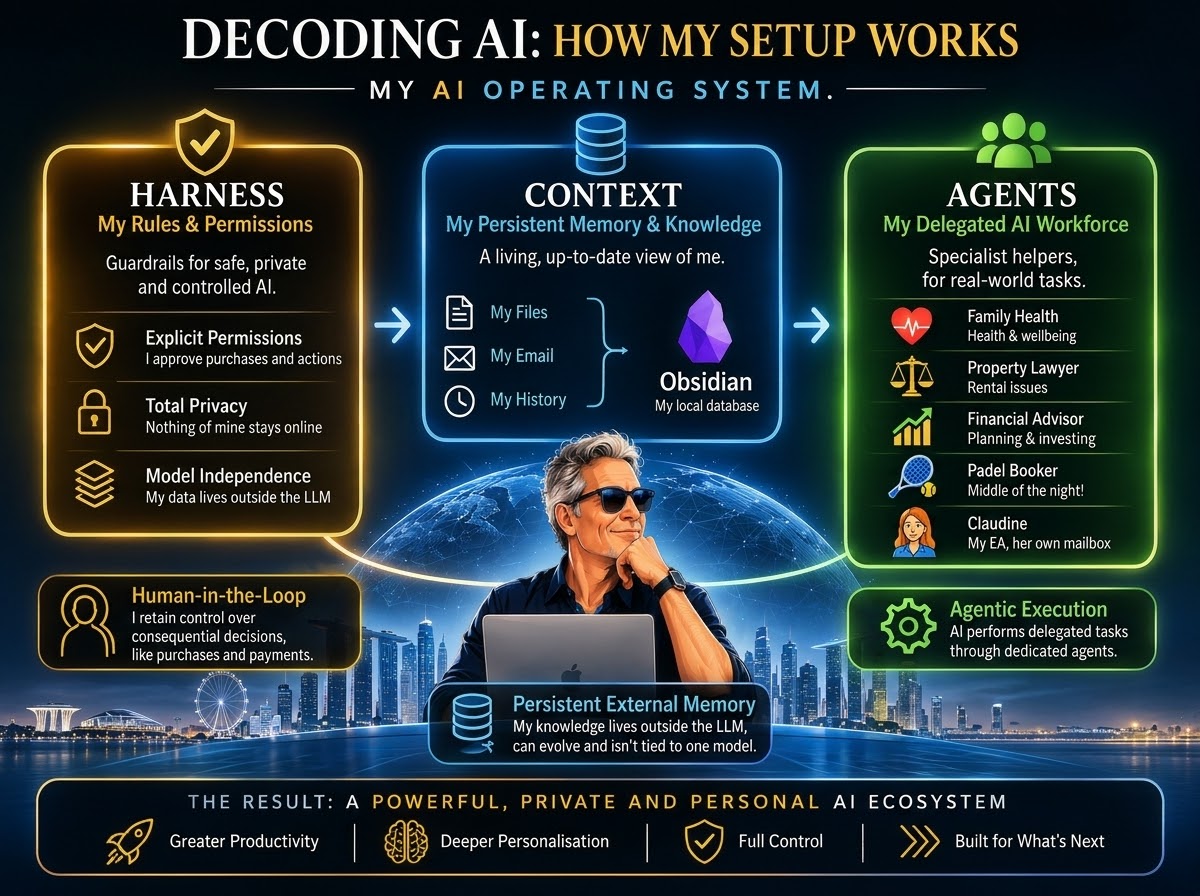
Decoding AI: my personal AI operating system.
I think of it as an operating system with three layers: a harness, context and agents. Each one also happens to decode a piece of AI jargon you’ll hear in most boardrooms right now.
Harness: my rules and permissions
In AI, the harness is everything wrapped around the model: the instructions, rules, tools and limits that turn a clever text predictor into something you can trust to act. The model is the engine. The harness is the steering, brakes and seatbelts.
Mine is written down. A short set of instructions that every AI session reads first: what it may read, what it may change, what it must never store (no account numbers, no passwords), which personal topics stay in their own folders, and how to write (British English, short notes, dated lines). Claude follows my guidelines and constraints, every time, because they’re part of the setup rather than something I have to remember to type.
Three principles sit at the heart of it. Explicit permissions: AI does nothing that matters without my OK. It can draft an email, but it doesn’t send one until I say so. It can find a booking, but it doesn’t pay for it. Privacy by tier: not every tool sees everything. Sensitive personal material only goes to the tools I trust most, with identifying details stripped where possible, and some tools only ever see what I’d be happy to publish. And model independence: my knowledge lives outside any one model. If a better model comes along tomorrow, I switch the engine and keep the car.
That first principle has a name: human-in-the-loop. It gets thrown around as a reassuring slogan, and, as Sangeet Paul Choudary argues in Harvard Business Review, on its own it isn’t a strategy for transforming work. But for anything consequential, purchases, payments, messages that go out in my name, it’s non-negotiable. I stay in the loop. Always.
Context: my memory
Ask a chatbot a question and it starts from zero. It doesn’t know you, your family, your projects or what you decided last week. That gap is a big part of why so much AI output feels generic. The fix is context: giving the model the right information at the moment it needs it.
My context lives in Obsidian, a note-taking app that stores everything as simple text files on my own machine. I call it my second brain. Projects, people, decisions, writing, admin, all organised in folders with dated logs. I don’t edit it by hand any more; Claude does, following the rules in the harness. Every task starts with the AI already knowing me and the relevant history, and every task ends with it writing back what changed. The memory gets better every time I use it.
This decodes two more terms. Persistent memory is simply knowledge that survives beyond a single chat. And when Gartner names AI context platforms among its top strategic technology trends for 2027, this is the enterprise version of the same idea: giving AI agents the knowledge they need to act in line with the business, and warning that without it you get overprivileged agents, compliance failures and low trust. Harness and context, at company scale. AI is only as good as the knowledge you give it. It was always about the data.
Agents: my team
An agent is AI that doesn’t just answer, it acts. It takes a goal, breaks it into steps, uses tools (email, calendar, files, websites) and gets on with it, coming back to me when a decision is needed. Agents are built from skills: written, repeatable instructions for a specific job, so the AI does it the same way every time.
Here’s my team today. Each one does a job I’d otherwise do badly, late or not at all:
- Claude + Obsidian is the base. Claude is where the thinking, writing and building happens; Obsidian is where it’s remembered.
- Skills I’ve built myself, rather than downloading other people’s: filing notes in the right place, capturing ideas, a monthly health check of the whole vault, a tool router that tells me which AI to use for a task (with a privacy check first), and an insurance claims checker that audits reimbursements against the policy.
- Standing agents for the long-running parts of life: family health admin, a property issue, finances. Each has its own brief and reads across everything relevant before it answers.
- A padel booker that grabs weekend courts the moment the booking window opens, in the middle of the night, then adds it to the calendar and drafts the message to the group.
- Claudine 👩🏻💻, my AI assistant, with her own mailbox. She emails me summaries and reminders, and writes to other people only when I ask, always copying me.
- Gemini, through Google Workspace, working across my mail and calendar, and for research and long documents.
- Mizzy, Meta’s Muse, also with her own mailbox. She handles the low-stakes, non-private errands: restaurant and hotel bookings and the like. By design she never sees anything personal.
Why several tools instead of one? Because they’re good at different things, and because they deserve different levels of trust. Using more than one also keeps me honest: for anything that matters, I draft in one and check in another.
All of this, without a Mac mini
This year the Mac mini became the must-have accessory for AI tinkerers, with people buying one, or three, to run autonomous agents around the clock at home. I get the appeal. But I don’t have one, and I don’t need one. My setup runs on the laptop and phone I already own, a Claude subscription, a free note-taking app, and the cloud for the jobs that need to happen at 3am. No home server, no coding, no hardware arms race.
The hard part was never the hardware. It was deciding what I wanted done, writing the rules and keeping the knowledge clean. That’s the whole job, really.
Is it perfect? No.
Things break. A rule I thought was clear turns out not to be. An agent does exactly what I asked rather than what I meant. Every one of those moments taught me something about the work itself, which is the point. Each fix forced me to define the inputs, outputs and outcomes more clearly than I ever had before.
Has it changed how I work and live? Completely. Not because AI does my thinking. It doesn’t. It sharpens it, remembers it and acts on it, inside rules I set.
And that’s what I’d say to any leader asking where to start. Don’t start with a tool. Start with yourself. Build your own small operating system, learn where it helps and where it fails, and you’ll walk into the bigger conversations knowing what you’re talking about. Then do the hard part: bring your people with you.
AI isn’t just a chatbot. It’s an operating system, built around you.
Marketing hasn’t changed, but marketers must.
Further reading
- Anthropic Economics, Working with AI (November 2026): 66 interviews at 58 companies on what actually happens when AI meets real work.
- Christopher Stanton, Justin Shriber and Simon Rudat, What Top Performers Do Differently with AI, and Why They See the Biggest Benefits, Harvard Business Review (2026).
- Gartner, Top Strategic Technology Trends for 2027, including AI context platforms.
- Sangeet Paul Choudary in Harvard Business Review on why “human-in-the-loop” is not, on its own, a strategy for how AI transforms work.
Thinking is mine, writing supported by Claude, visual created with ChatGPT.