
 When I was dean of the Brand Marketers Academy at Cannes this year, one of our speakers was a cardiothoracic surgeon, JaBaris Swain. He wasn’t there to talk about hearts. He was there to talk about creativity in the operating theatre — planning, prep, brand codes, the frame you build so you can actually be creative inside it. “Constraint is the canvas,” he said. And this one has stayed with me since: “We don’t plan to fail; we plan so failure doesn’t get to improvise.”
It struck me that some of the best thinking on marketing right now isn’t coming from marketing at all. It’s sitting in other disciplines, waiting to be borrowed. Surgery is one. Physics, for me, has been another.
I spend a lot of time thinking about journeys. Funnels, loops, spirals, whatever shape we’re drawing on the whiteboard this quarter.
And I keep coming back to two forces that explain almost everything about whether a customer moves, or stays put.
Friction. And gravity.
Friction is the tax on every step
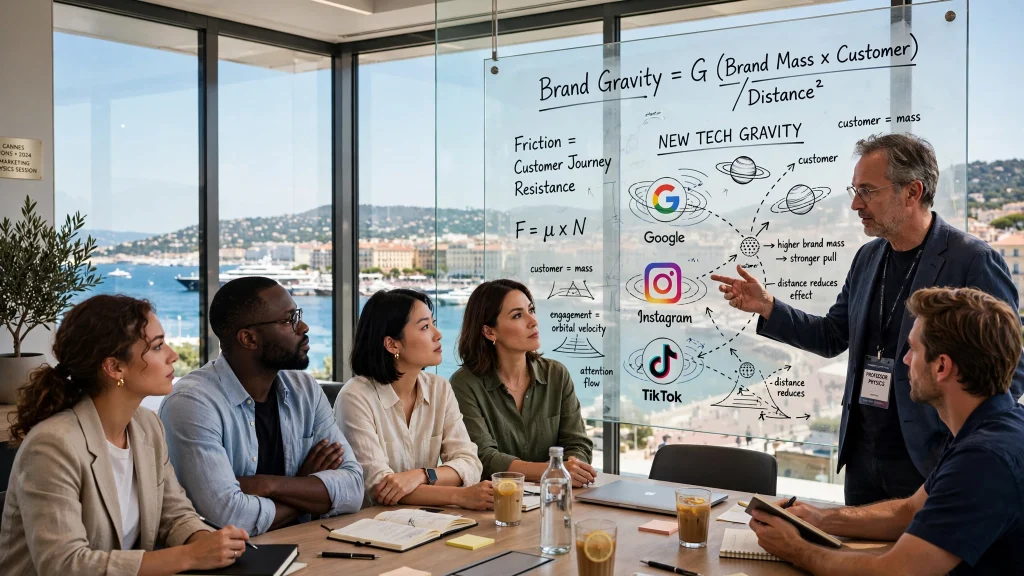
Physics has a formula for this, and it’s a simple one: the force needed to overcome friction is how rough the two surfaces are, multiplied by how hard they’re pressed together.
Translate that and the roughness is the process itself — how many logins, how many mismatched screens, how many steps that don’t need to exist. The pressure is the weight of the decision. A subscription renewal barely registers. A mortgage carries a lot. So a small amount of roughness can kill a low-consideration purchase stone dead, while a high-consideration one will push through a lot more friction to get there. Kotler’s foundational idea was that marketing exists to facilitate exchange. Every barrier he catalogued under access, convenience, and information is that same roughness and weight, wearing a different name.
Marketing is no different in practice. Every step in a journey carries some friction of its own. How hard is it to find the information you need? Is that information the same on the website as it is in-store, as it is on the app? How many clicks between “I want this” and “I have this”? Can you configure it without calling someone?
Every bit of inconsistency, every extra click, every moment of doubt — that’s friction. And it doesn’t just slow the journey down. It bleeds people out of it entirely.
This is the unglamorous side of marketing. Nobody wins an award for reducing a checkout flow from five steps to three. But it’s often the highest-leverage work you can do, because friction compounds. A little lost at every step adds up to a lot lost by the end.
Gravity is what pulls you back
Friction alone doesn’t explain behaviour, though. If it did, the easiest option would always win. It doesn’t.
That’s where gravity comes in. Newton’s version of the pull between two objects works on three things: how much mass each object has, and how far apart they are. More mass on either side means a stronger pull. More distance means a weaker one, and it weakens fast — twice the distance means a quarter of the pull, not half.
Translate that and one side is the mass of the brand. The other is the mass of the need sitting in the customer’s mind, how real and present it currently is. And the distance is psychological, or category, or simply how many touchpoints stand between where the customer is and where you are. Grow the mass on either side, or shrink the distance, and the pull increases. That’s the entire logic behind distinctive assets and category entry points — they don’t create demand, they shrink the distance for demand that already exists.
And gravity, in marketing, has two forms.
Physical gravity is availability. The product being where you already are. The subscription that renews without you thinking about it, the refill that shows up, the app already on your phone, the aisle you walk down out of habit. This is pure Byron Sharp and Ehrenberg-Bass territory — physical availability isn’t a nice-to-have, it’s the mass of the brand. The bigger the mass, the stronger the pull. You don’t have to convince someone to come back if they never really left.
Mental gravity is the emotional and cognitive version of the same idea. Mental availability — how much space you occupy in someone’s head, and how easily they can retrieve you when a need arises. This is where Binet and Field’s long-and-short-of-it thinking earns its keep. Short-term activation shrinks the distance to purchase for demand that already exists right now. Long-term brand building grows the brand’s mass so the pull persists no matter how far away that distance happens to be on any given day. Brand building isn’t decoration, it’s mass-building. Every bit of emotional resonance, every distinctive asset, every memory structure you lay down — that’s gravity accumulating. And unlike friction, gravity works even when nobody’s actively “in the funnel.” It pulls people back into orbit long before they’ve consciously decided to buy.
Two forces, two jobs
Here’s the bit I think gets missed. Reducing friction is an activation job — short-term, tactical, CX and ops adjacent. Building gravity is a brand job — long-term, cumulative, often invisible in the quarter it’s built.
Most organisations are set up to reward the first and neglect the second, because friction shows up in a dashboard and gravity shows up in a P&L three years from now. Mark Ritson has built a career hammering this exact point — marketers and their organisations conflating short-term activation with long-term brand building, and rewarding whichever one is easiest to measure this quarter. His argument was never that one matters more than the other. It’s that they’re two parts of the same equation, and fighting over the same budget line as if only one can win misses the point entirely.
But you need both. A brand with huge mental gravity and terrible friction still loses the sale at the last click. A brand with zero friction and no gravity is just the cheapest, most forgettable option in the category — easy to leave, because nothing was pulling anyone back in the first place.
Media has a buy side and a consumer side, and they don’t always agree
Neither force stays still, though. It’s worth tracing how differently they show up depending on where you look, starting with media, since that’s where most of the pulling happens before anyone’s even decided to buy.
Media is where these forces get complicated, because there are two audiences experiencing them at once. The consumer, moving through content. And the marketer, moving money through platforms to reach them. Friction and gravity show up differently for each.
Start with the consumer side. The open web atomised first. One era, and your attention was splintered across a browser’s worth of tabs, feeds, and destinations — friction everywhere, because every platform had its own login, its own format, its own rules. Then the pendulum swung the other way. Consolidation. People stopped living on the open web and moved into apps — a handful of them, each one a walled garden with its own gravity. You don’t browse anymore, you open an app out of habit, the same way you’d walk into a shop you already know. That’s mental and physical availability fused into a single icon on a home screen.
And within those apps, gravity now has to work across formats. Video, imagery, text, news, short-form, long-form, all pulling on the same person in the same session. A brand’s mass isn’t just about being present, it’s about having enough coherent mass across every one of those formats that the algorithm — and the person — keep landing back on you rather than drifting past.
Now the buy side. Atomisation was a nightmare for media buyers too — a hundred platforms, a hundred sets of targeting logic, a hundred dashboards, none of them talking to each other. That’s friction at an operational level, not a consumer one. Consolidation helped, in theory — fewer, bigger platforms to plan against. But it also concentrated the gravity in a handful of gatekeepers, which means the price of admission to that gravity went up.
And now both sides are being pulled toward the same new center at once. Consumers are drifting back to search, except the search bar is increasingly a conversation with an LLM instead of a list of blue links. Marketers are watching that shift and asking the same question the consumer is unconsciously asking: who has enough gravity to be pulled into that conversation.
That’s a gravity problem at its core, just with a new kind of mass. How consistent is a brand across the internet. How consolidated is the information about it, rather than scattered and contradictory. How often it appears inside the conversations actually happening on these platforms. Consistency and consolidation, that’s mass, in the physics sense. Large language models are, underneath everything, probabilistic — predicting the most likely, best-supported next answer. A brand with real gravity, coherent and well-documented, has a higher chance of being pulled into that answer. Not a shelf you stock or an app you build anymore. Just a weight you carry, that pulls the model, and the person on the other end of it, toward you.
How commerce has rewired both forces
Commerce goes through the same cycle, just a beat later — after the attention’s already been won.
Pre-ecommerce, pre-COVID, gravity was the retailer. Your brand’s gravity was borrowed — it lived inside someone else’s store, on someone else’s shelf. Friction and gravity were fused together in one place: how easy was it to get to that retailer, how good was the in-store experience (what we’d call UX today), and was the brand physically available where you were already inclined to go. Sometimes gravity won before you’d even thought about buying, because the brand was simply there, in your path. Other times it was pure impulse — you head down Oxford Street on a Saturday with no plan, and something pulls you in.
Early ecommerce was almost entirely a friction story, and a badly executed one. Create an account. Build a basket. Dig out a credit card. Get bounced between three different platforms before you’ve even checked out. All that friction was self-inflicted — the industry built the resistance it then spent a decade trying to remove.
The latest wave — quick commerce, social commerce — is the first time both forces are being engineered at once, deliberately, in the same product. One-click accounts. Saved profiles. A journey from awareness to purchase compressed into minutes, sometimes seconds. TikTok Shop is the clearest example — impulse and infrastructure fused, the whole funnel collapsed into a single scroll.
What this means for brand building now
Put all of that together and it starts to reshape what brand building actually is.
Gravity is built through consistency. Vision, mission, purpose, the cues and assets that let someone recognise you before they’ve consciously registered why. Delivered the same way, again and again, across every place a person might encounter you. That consistency is what turns a passing impression into an emotional connection, and it’s also what turns a rational case for choosing you into something a person can actually retrieve when they need it. Mental availability isn’t a slogan, it’s the accumulation of a thousand consistent touches.
But gravity doesn’t just live in messaging anymore. It lives in the experience itself. Every interaction a brand delivers — the app, the checkout, the customer service call, the unboxing — is another place those same cues and that same purpose either show up, or don’t. And when that experience is also frictionless, something interesting happens. It stops being two separate jobs. A joyful, effortless experience builds the brand at the exact same moment it’s moving someone through the funnel toward purchase. The gravity and the friction reduction happen in the same interaction, reinforcing each other rather than competing for budget.
That’s the real shift. Brand building used to be what happened before the funnel, and experience was what happened inside it. Now the best brands are building gravity and removing friction in the same breath, because the experience is the brand, every time someone has it.
The conclusion physics already gave us
Newton’s first law says an object stays in motion, or stays at rest, unless a force acts on it. Left alone, a customer doesn’t move toward you. Something has to act on them.
Newton’s second law is the more useful one for us. Force equals mass times acceleration. Put the two ideas from earlier together and you get a working picture: the pull toward your brand comes from your mass, built through physical and mental availability, acting over whatever distance still separates you. Working against it is the friction generated by how rough the process is, scaled by how weighty the decision feels.
Increase the mass, and you need less force elsewhere to close the sale. Remove the friction, and the mass you already have converts into motion faster. Neglect either one, and the other has to work twice as hard to compensate.
That’s the whole job, really. Not chasing a single campaign or a single channel, but managing the net force. Building enough gravity that people are pulled toward you before they’ve consciously decided to move, and stripping away enough friction that when they do move, nothing stands in the way.
Where’s the net force weakest in your business right now — not enough mass, or too much drag?
Thinking by Lex, writing in partnership with Claude.
